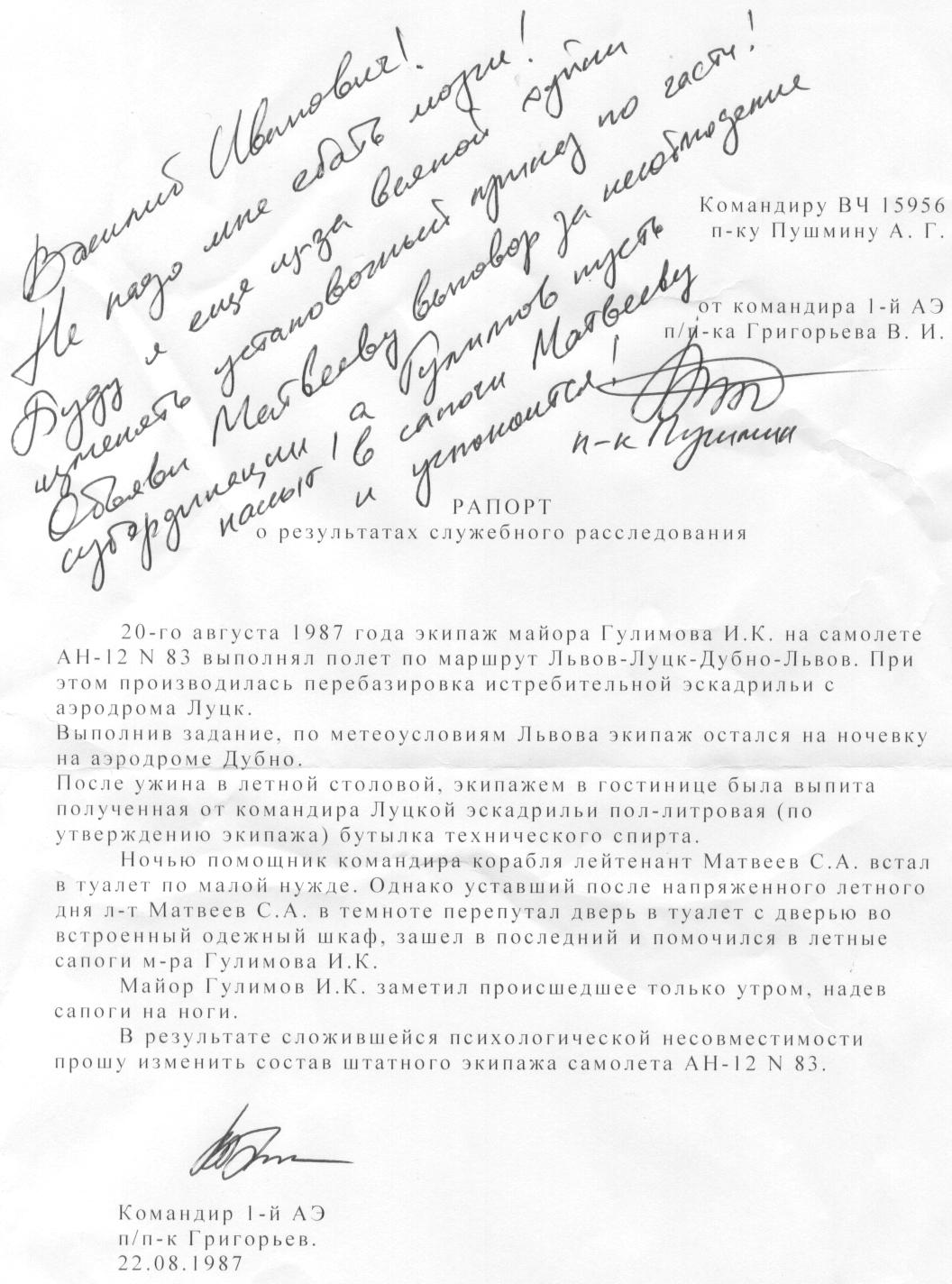
That was a somewhat ironic statement. The gist of it runs as such: This is an official report detailing the events of one particular aircraft of the fighting batallion after it had finished his rounds. The plane made a stop in Lvov (Lviv now) and some of the major officials got completely wasted after drinking a half liter bottle of the equivalent of rubbing alcohol. Anyway, one of the Leutenants got so drun that he mistook the door of the bathroom with the door of the closet, and in his drunken stupor pissed in the boots of his high ranking officer.
The higher ranking officer didn't realise this until the next day when he stuck his foot in his boot.
This is a statement asking, in the most official of terms for a staff change on this particular aircraft due to these unfortunate events.
Since this is a language board, I feel like I need to add some linguistic commentary. In Russian, official documents are always written in the passive voice. This document is full of past participles and other such stuff (which is cool if you're a language geek such as myself) Like, when they're mentioning the bottle of alcohol that was downed, the letter says something to the effect of "After dinner in the summer cafeteria, a half-liter (as confirmed by the investigation) of Tekhnicheskii alcohol that was received from the commander of the Lutsk batallion was drunk." It's funny in Russian... just trust me.
I can't read the stuff in script because I can't make it out.
Russians: I did understand that, yes? I don't know the background behind those two particular officers, since I'm not a native speaker, but I think you get the idea.
The script is fairly rude, and says something like: Don't fuck with my mind. I don't want to break up the flight squad. Why doesn't the high ranking officer piss in the offenders boots?
Apparently it's much funnier in Russian. :P
My Russian skills are suck, BTW. Just so you're not mislead. I had to get my boy to translate it for me. For his own part, he was quite amused with this.
Transcription of the written part (apologies for the strong language):
Василий Иванович!
Не надо мне ебать мозги! Буду я еще из-за всякой хуйни изменять установочный приказ по части! Объяви Матвееву выговор за несоблюдение субординации, а Гулимов пусть насыт в сапоги Матвееву и успокоится!
Cut the brainfucking out! I'm not gonna change the orders for the unit because of some lame shit! Reprimand Matveyev for insubordination, and let Gulimov piss into Matveyev's boots and calm down!
First, obviously not typewritten. Second, the font is different from the ones used in Russian (or any) Cyrillic typewriters.
So it's a fake.
But it represents well certain aspects of the Soviet military service: camaraderie and informality of cordial relations between those who wear boots and those who piss in them.
It also represents another funny aspect of Russian military language. I can't remember exact details.... but somewhere in the 1970s the U.S. military investigation produced a memorandum in which they claimed that average Russian text was some 20 per cent longer than the equal English text, which leaded (as they claimed) to the fact that Russian officers' orders were slower than the American, which, in its turn, leaded to a significant slowness of Russian military machine. The only fact they did not know was that in case of real emergency, Russian officers promptly switch into obscenities which are far more quick and clearly understood for the Russian military men than English "military speak" for the American military men :)
Recently I read an article about "war language". Some things about navaho on the radio, some things of Orwell's "newlang" and so on. One of the article's thesis was that russian commanders, using foul words that are much shorter than official orders, were for soldier's reaction to be faster than in case of long commands. There were examples of WWII unofficial orders issued by americans, nazis and soviets. The last ones were significantly shorter than others. I don't pretend to be truethfull, I just read it in a very respectable magazine. E.g.: "Fire in the hole!" --- "Limonka!" "Get the fuck outta here!" --- "Uebyvaite!"
And these weren't "obscenities", because we do understand the meaning of such orders above the morality or something.
![[identity profile]](https://www.dreamwidth.org/img/silk/identity/openid.png) 8d9.livejournal.com posting in
8d9.livejournal.com posting in ![[community profile]](https://www.dreamwidth.org/img/silk/identity/community.png) learn_russian
learn_russian![[personal profile]](https://www.dreamwidth.org/img/silk/identity/user.png) timeasmymeasure
timeasmymeasure


no subject
Date: 2004-07-22 02:52 pm (UTC)no subject
Date: 2004-07-22 04:33 pm (UTC)no subject
Date: 2004-07-22 08:10 pm (UTC)This is an official report detailing the events of one particular aircraft of the fighting batallion after it had finished his rounds. The plane made a stop in Lvov (Lviv now) and some of the major officials got completely wasted after drinking a half liter bottle of the equivalent of rubbing alcohol. Anyway, one of the Leutenants got so drun that he mistook the door of the bathroom with the door of the closet, and in his drunken stupor pissed in the boots of his high ranking officer.
The higher ranking officer didn't realise this until the next day when he stuck his foot in his boot.
This is a statement asking, in the most official of terms for a staff change on this particular aircraft due to these unfortunate events.
Since this is a language board, I feel like I need to add some linguistic commentary. In Russian, official documents are always written in the passive voice. This document is full of past participles and other such stuff (which is cool if you're a language geek such as myself) Like, when they're mentioning the bottle of alcohol that was downed, the letter says something to the effect of "After dinner in the summer cafeteria, a half-liter (as confirmed by the investigation) of Tekhnicheskii alcohol that was received from the commander of the Lutsk batallion was drunk." It's funny in Russian... just trust me.
I can't read the stuff in script because I can't make it out.
Russians: I did understand that, yes? I don't know the background behind those two particular officers, since I'm not a native speaker, but I think you get the idea.
no subject
Date: 2004-07-22 09:35 pm (UTC)Apparently it's much funnier in Russian. :P
My Russian skills are suck, BTW. Just so you're not mislead. I had to get my boy to translate it for me. For his own part, he was quite amused with this.
no subject
Date: 2004-07-22 11:10 pm (UTC)One thing, the comment in the parentheses says "a half-liter (according to the crew's claim) bottle", which is also funny.
no subject
Date: 2004-07-22 09:37 pm (UTC)Василий Иванович!
Не надо мне ебать мозги! Буду я еще из-за всякой хуйни изменять установочный приказ по части! Объяви Матвееву выговор за несоблюдение субординации, а Гулимов пусть насыт в сапоги Матвееву и успокоится!
П-к (полковник) Пушнин
no subject
Date: 2004-07-22 10:41 pm (UTC)Vasily Ivanovich!
Cut the brainfucking out! I'm not gonna change the orders for the unit because of some lame shit! Reprimand Matveyev for insubordination, and let Gulimov piss into Matveyev's boots and calm down!
Colonel Pushnin
no subject
Date: 2004-07-23 12:35 am (UTC)this is brilliant
Fake
Date: 2004-07-23 08:15 pm (UTC)So it's a fake.
But it represents well certain aspects of the Soviet military service: camaraderie and informality of cordial relations between those who wear boots and those who piss in them.
Re: Fake
Date: 2004-07-27 08:49 am (UTC)Unfake
Date: 2004-07-28 08:12 pm (UTC)There were examples of WWII unofficial orders issued by americans, nazis and soviets. The last ones were significantly shorter than others.
I don't pretend to be truethfull, I just read it in a very respectable magazine.
E.g.:
"Fire in the hole!" --- "Limonka!"
"Get the fuck outta here!" --- "Uebyvaite!"
And these weren't "obscenities", because we do understand the meaning of such orders above the morality or something.
Re: Unfake
Date: 2004-07-29 04:32 am (UTC)Re: Unfake
Date: 2004-07-29 04:55 am (UTC)Re: Fake
Date: 2004-07-28 01:37 pm (UTC)no subject
Date: 2004-08-02 12:34 pm (UTC)no subject
Date: 2004-08-02 12:40 pm (UTC)